
Energy utilization, is one the aspects, with greater influence in our future. It is clear the need for a holistic approach towards decarbonization by 2050. A combination of technologies, procedures, regulations, having into consideration environment, social and economic aspects will support the goal to achieve climate neutrality.
New technologies are revolutionizing the way companies manufacture, improve and distribute their products.
Those include, among others, Internet of Things (IoT), cloud computing and analytics, Artificial Intelligence(AI), leading to the concept of smart factory. Data collection, analysis and assessment, will allow a better decision making process. Digital technologies lead to increased automation, and machine learning into their production facilities and throughout their operations, predictive maintenance, self-optimization of process improvements.
New level of efficiencies and responsiveness to customers services, and above all, capability for improvements on the environment, social and economic aspects.
Change is a challenge, and new technologies are disruptive, raising complexity (many variables with un-known or unknowable consequences), uncertainty (inability to assess risk versus benefit assessments), ambiguity (involving conflicts over ethics, and relationship with human).
Our future is a race between the growing power of our technology and the wisdom with which we use it. Let’s make sure wisdom wins (Stephan Hawking, 2018)
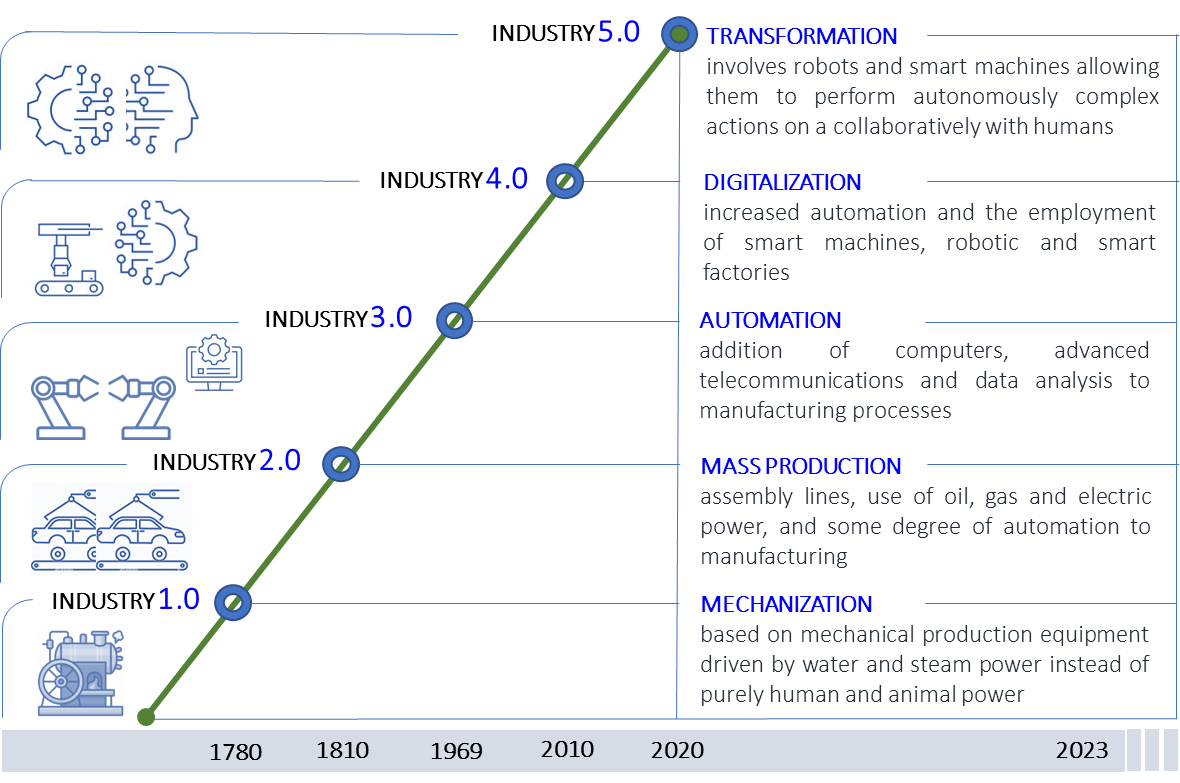
Briefly in one and a half century, we’ve been through the so called industrial revolutions. From late 18th century with the 1st Industrial Revolution to our days It is fairly accepted that we are now the Industry 4.0, in the edge of Industry 5.0.
First industrial revolution
The first industrial revolution dating back in the late 18th century in Britain was the transition to new manufacturing processes using water and steam and helped enable production by using mechanical power instead of purely human and animal power. Machine use become more feasible, allowing faster and easier production, supporting innovations and technologies, manufacturing a larger number of various goods and creating a better standard of living in general.
Second industrial revolution
The second industrial revolution introduced assembly lines and the use of oil, gas and electric power. These new power sources, along with more advanced communications via telephone and telegraph, brought mass production and some degree of automation to manufacturing processes. In particular electrical technology allowed for even greater production and more sophisticated machines.
Third industrial revolution
The third industrial revolution, on middle of the 20th century, began with the first computer era. Regardless their initial simplicity and size relative to the computing power, with more advanced telecommunications and data analysis they were able to provide, improvements to the manufacturing processes. The digitization era started with the introduction of embed programmable logic controllers (PLCs) into machinery to support automation of some processes. Internet and connectivity created automation advancements considerably.
Fourth industrial revolution
The fourth industrial revolution, (referred to as Industry 4.0), is the era of smart machines, storage systems and production facilities that can autonomously exchange information, trigger actions and control each other without human intervention. There is an increasing automation and the employment of smart machines and smart factories, informed data helps to produce goods more efficiently and productively across the value chain. The usage of mechanical devices using computer-based algorithms, interconnected networks of machine devices and vehicles embedded with computerized sensing, scanning and monitoring capabilities, cloud computing, and technological platforms that employ artificial intelligence, support a smart factory with information transparency and better decisions, better meeting customer demands using mass customization, with higher levels of efficiency.
Industry 5.0?
We are already in the edge of the fifth industrial revolution (known as Industry 5.0), allowing customers to customize what they want. This allows us to blend the power of smart, precise, accurate machinery with human creativity and ingenuity. Such intelligent automation in manufacturing incorporates effective processes that require fewer resources and less human involvement, helping the business efficiency. Industry 5.0 technologies make it possible to avoid accidents caused by human error (humans are not involved or perform only monitoring roles). An Industry 5.0 plant is a machine-operated factory, with all actions automated. It can even control and analyze what it does by itself, performing far more calculations than a human can.
By connecting the way in which man and machine work together, estimates say that Industry 5.0 will mean that over 60% of manufacturing, logistics and supply chains, agri-farming, and the mining and oil and gas sectors will employ chief robotics officers by 2025.
The European Economic Social Committee asserts that, “The proliferation of robotic automation is inevitable.”
Additional Readings:
industry 4.0 transformation Europe’s manufacturing sector | EIT (europa.eu)